

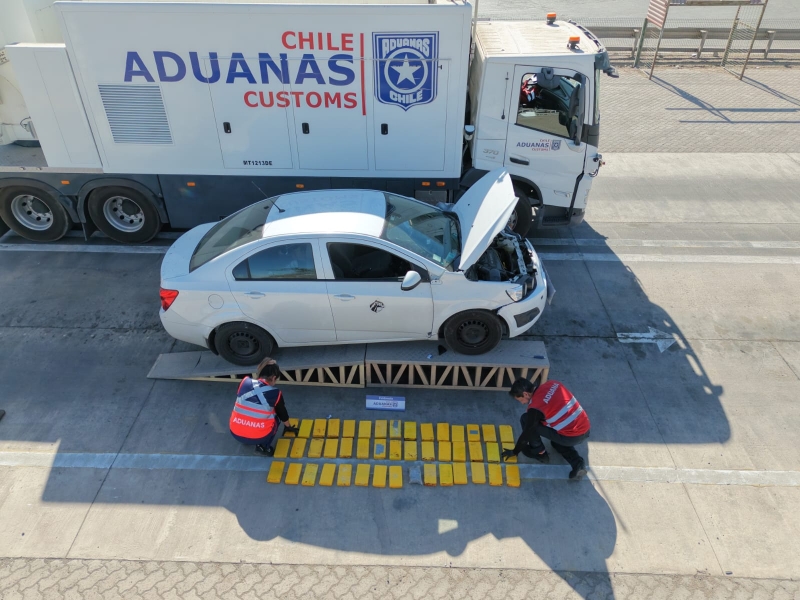
More than 51 kilos of various illicit substances were detected by officials from the Iquique Regional Customs Directorate during three inspection procedures carried out over the weekend at the Colchane and Quillagua border controls.The operations made it possible to discover different methods used to transport drugs, highlighting a discovery of 44 packages of cocaine hydrochloride hidden in the structure of a private vehicle, whose detection was made possible thanks to the analysis of images from the Customs scanner truck.
This incident occurred at the Quillagua checkpoint when officials selected a car traveling from Iquique to Santiago for inspection. During the vehicle scan, operators detected a suspicious image in the dashboard area, prompting a more thorough physical inspection.
The inspection revealed a false bottom compartment in an aluminum structure, where 44 packages containing 45.4 kilograms of cocaine hydrochloride were hidden. An additional package containing 990 grams of marijuana was also found concealed in the same area of the vehicle.In another operation in Quillagua, officers from the Drug Enforcement Unit detected a passenger on an intercity bus carrying three packages strapped to his back. The man admitted to carrying the substances, which had been delivered in Iquique for transport to Santiago. Field tests confirmed that the packages contained 3.6 kilograms of cocaine base.
The third discovery took place at the Colchane Border Complex, where the work of a detection dog made it possible to discover four packages hidden under the seats of an international bus coming from Oruro, Bolivia, bound for Iquique.
The alert from the canine unit allowed officers to focus their inspection on the upper deck seats of the vehicle. Upon searching that area, they found two packages containing 1.134 kilograms of cocaine base and two more containing 1.137 kilograms of ketamine.
The Acting Regional Director of Customs in Iquique, Narciso Donoso, highlighted the importance of these results and the work of the inspection teams:“
These seizures are yet another example of the oversight we carry out at the Tarapacá checkpoints, where we combine intelligence, risk profiling, scanning technology, canine units, and the rigor of our teams to stop illicit substances from entering the country. No matter how sophisticated or innovative the concealment methods are, our operational and technological capabilities will remain vigilant.”