

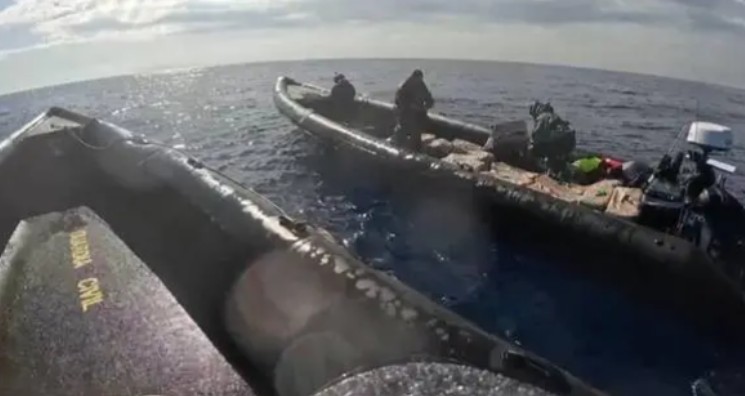
An international law enforcement operation led by the Spanish Guardia Civil and coordinated through Europol has disrupted a major cocaine trafficking route across the Atlantic Ocean.
Between 13 and 26 April 2026, law enforcement targeted criminal networks moving cocaine from Latin America to Europe through complex at-sea transfers designed to avoid major ports and traditional detection methods.
During the two-week operational phase, maritime assets were deployed across the Atlantic to detect, track and intercept suspect vessels involved in drug transfers at sea. Law enforcement activity focused on the eastern Atlantic corridor between the Spanish Canary Islands and the Portuguese Azores. In total, 11 tonnes of cocaine and 8.5 tonnes of hashish were seized during the operation.
Earlier this year, Europol issued a warning that criminal networks were increasingly shifting cocaine trafficking away from major European ports and towards fragmented maritime routes across the Atlantic Ocean. Since identifying this evolving modus operandi, Europol and its partners have intensified maritime coordination and operational cooperation to adapt to the threat, with this operation delivering the clearest results to date.
Operational results
- 11 tonnes of cocaine seized
- 8.5 tonnes of hashish seized
- 54 people arrested
- 8 vessels intercepted
Jean-Philippe Lecouffe
Europol’s Deputy Executive Director Operations
Our work proves that when law enforcement acts together, even the Atlantic is not big enough for organised crime to hide. Criminal networks are becoming increasingly flexible, and internationally connected. But our response is evolving fast too. Over a two-week operational period, law enforcement dealt a significant blow to what is known as the cocaine highway. And our work does not stop with seizures or the arrest of crew members – Europol will now build on the intelligence gathered to help identify and dismantle the criminal networks behind these trans-Atlantic operations.
Criminal networks have moved offshore
The recent operation demonstrates the patterns Europol had identified earlier this year: criminal networks are increasingly moving cocaine offshore to reduce exposure to law enforcement at major ports. Shipments are now moved in multiple stages across the Atlantic:
- Mother vessels collect cocaine in Latin America and travel hundreds to thousands of nautical miles into international waters. These vessels include container ships, bulk carriers, and smaller non-commercial vessels.
- Mid-ocean transfers move cargo onto high-speed vessels capable of long-range crossings, including rigid-hulled inflatable boats and other fast craft.
- Final-stage transfers deliver cocaine to smaller boats for landing at remote coastal areas in Portugal and Spain, often using beaches or small marinas to avoid detection.
The model is designed to fragment risk across multiple vessels and crews. The recent operation directly targeted this structure, halting multiple shipments and preventing criminal networks from completing their deliveries to Europe.
The international response
The operation was led by the Spanish Guardia Civil, together with the cooperation of law enforcement authorities of Italy, Portugal, United Kingdom, and the United States, with Europol providing operational coordination, intelligence development and analytical support throughout the action.
In addition, a Europol expert was deployed to Spain during the two-week operational window to cross-check operational data of the vessels as they were being monitored and intercepted at sea.
Initial findings from the operation indicate that:
- The international waters between the Canary Islands and the Azores are increasingly being used by criminal networks for large-scale cocaine transhipment operations, taking advantage of the area’s remoteness and the operational challenges linked to monitoring activity at sea;
- The area has become known among law enforcement as the ‘Cocaine Highway’ due to the growing number of vessels involved in moving cocaine towards Europe through this Atlantic corridor;
- Intelligence-led maritime operations, combined with coordinated tactical interventions at sea, are essential to disrupting this trafficking model. Europol plays a central role in this effort by connecting intelligence, operational data and international partners across both sides of the Atlantic.
Europol will continue analysing intelligence gathered during the operation to support ongoing investigations, identify linked criminal networks, and strengthen the targeting of maritime cocaine trafficking routes. Further arrests and seizures are expected as follow-up operational work continues.