

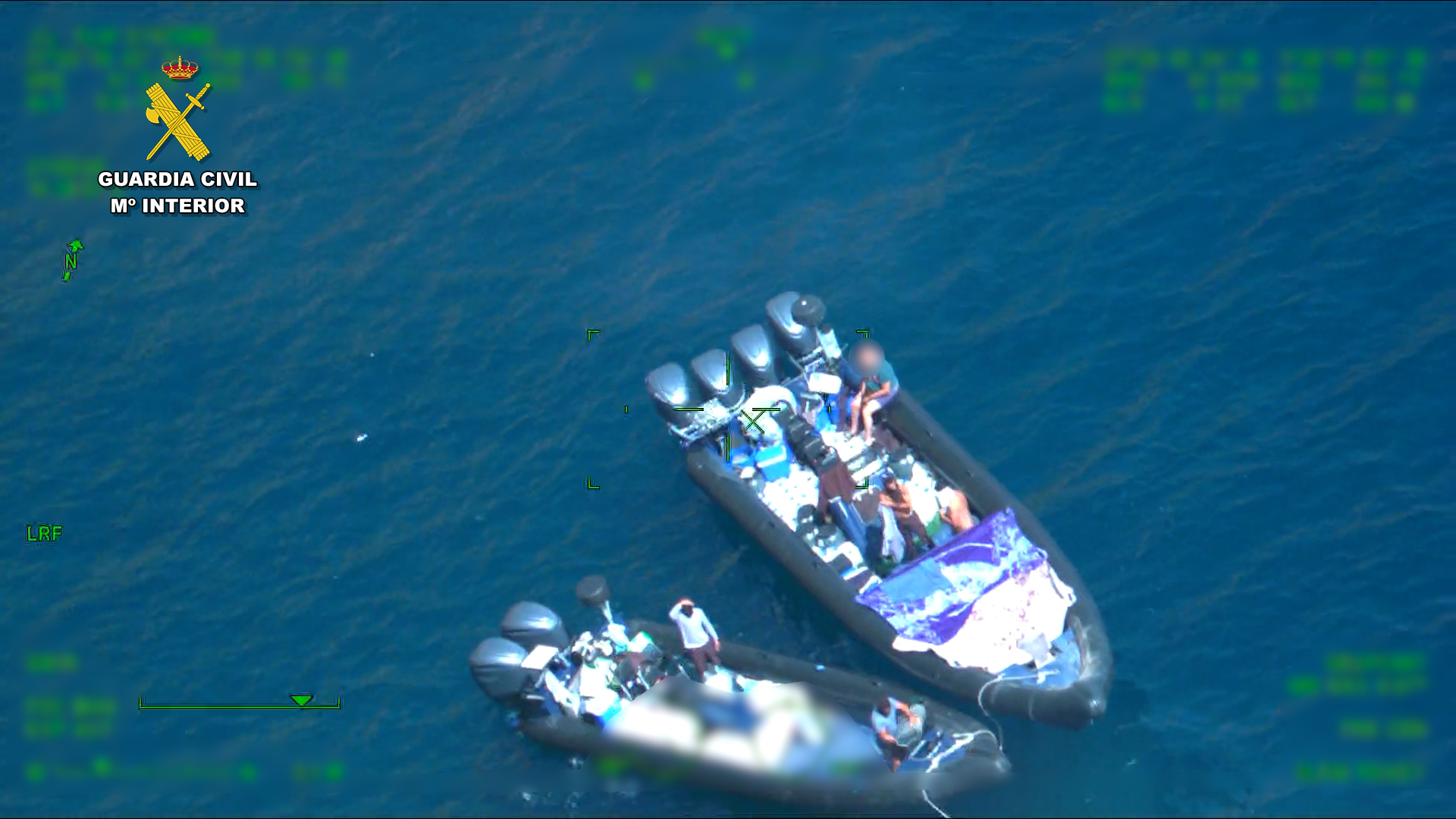
The Spanish Civil Guard has arrested four skippers of small boats used as taxis to transport migrants from the African continent to the Iberian Peninsula by landing them on the coast of Murcia. Two boats capable of carrying dozens of people per trip have been seized.
The actions were carried out a few days ago when the Civil Guard began an investigation aimed at identifying those responsible for illegally bringing people across the Murcian coast using taxi boats.
In Calblanque, Cartagena
On August 31, at least 63 migrants landed on a beach in Calblanque. Civil Guard officers found that some had injuries of varying severity. Their testimonies revealed that they had paid several thousand euros to board the boats and that the captains had assaulted them during the crossing.
Apparently, they were beaten to keep their heads down, and were even threatened and attacked with a machete and pepper spray when they approached the shore to make them jump in quickly, even though they couldn’t swim.
While the migrants were being assisted by the deployed Civil Guard patrols, a patrol boat from the Corps’ Maritime Service tracked the suspicious vessel, which had fled out to sea. It was located 12 miles southeast of Monte Cenizas and its two captains were arrested.
It is a vessel with four high-powered engines and a length of 15 meters that was seized and transferred to the port of Cartagena.
In Cabo Cope, Águilas
On September 2, another operation by the Civil Guard culminated in the interception of another inflatable boat, 10 meters long with two engines, in Cabo Cope, in Águilas.
This operation began when the Civil Guard, through the Integrated External Surveillance System, detected a suspicious vessel in the waters off Águilas, suspected of being involved in the illegal transport of people. A patrol boat from the Civil Guard’s Maritime Service and a helicopter from the Corps located a high-speed semi-rigid inflatable boat anchored near Cabo Cope.
Upon noticing the police presence, the crew started their engines and fled at high speed, ignoring the Civil Guard officers’ instructions. Despite repeated orders from the patrol boat to stop, they continued on their way, eventually coming face to face with the Civil Guard vessel and forcing them to make a sharp turn to avoid a head-on collision.
After this, the suspects’ vessel became perpendicular to the official patrol boat and began a dangerous maneuver that, given the proximity of the two vessels, would cause the Corps’ vessel to collide with it.
Faced with the impossibility of avoiding the collision, one of the officers drew his service weapon and fired two warning shots, without injuring any of the occupants.
Even so, the suspicious vessel caught up with the Corps’ boat on one of its sides. Then, it began its escape out to sea, while the crew threw fuel drums overboard.
Once they had recovered from the collision, the Civil Guard officers resumed their pursuit and managed to catch up with the vessel, board it, and arrest its two occupants. The boat still had 28 jerrycans of gasoline.
As a result of the collision and impact, three Civil Guard officers suffered minor injuries.
The investigation carried out by Civil Guard officers specializing in the investigation of criminal offenses related to facilitating irregular immigration, drug trafficking and its derivatives, made it possible to link this vessel to the one intercepted in the waters of Cartagena days before.
In both cases, high-speed, large boats were used, with several engines of up to 350 horsepower each.