

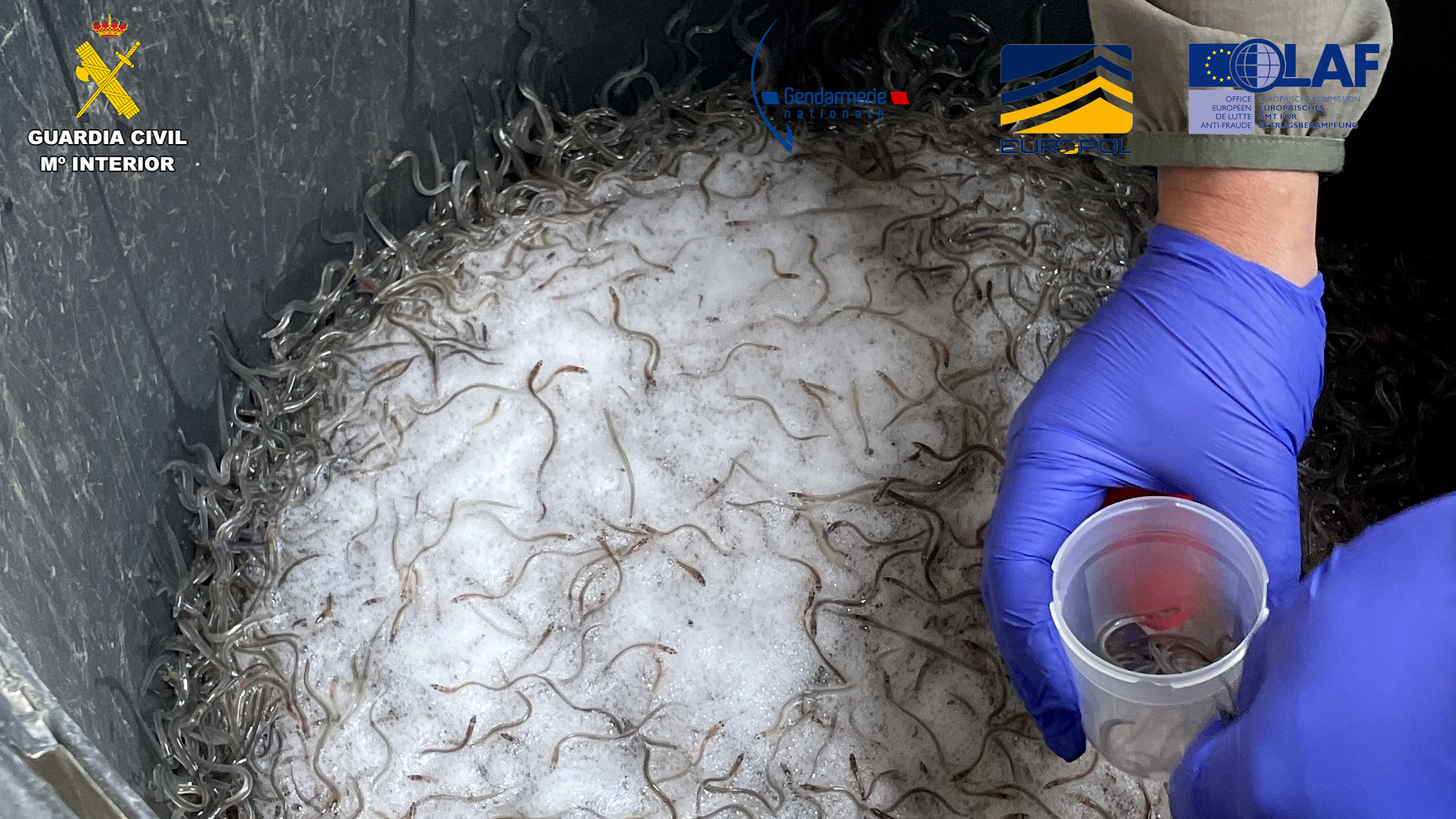
The Spanish Civil Guard has dismantled a criminal organization dedicated to the illegal trafficking of European eels, a protected and endangered species that commands a high market value. As a result of the international operation, dubbed “Putzua,” 10 people have been arrested in Gipuzkoa and France, and more than 400 kilos of eels have been seized.
The investigation began in early 2025 when a network of poachers, based between southern France and the Basque Country, was detected systematically failing to declare their catches. This allowed them to break the traceability of the fish and sell it to a Spanish company for illegal distribution within Spain.
As a result of the investigation, four people have been arrested in Gipuzkoa. Searches were conducted at business premises, fish farms, and private residences, resulting in the seizure of 28 kilograms of live elvers and 407 kilograms of frozen elvers. This merchandise lacked sanitary controls and traceability, rendering it unfit for human consumption. Finally, €65,000 in cash of unexplained origin was confiscated.
Meanwhile, in France, six searches and six arrests were carried out, with the seizure of 10 kilos of frozen elvers and 13,000 euros in cash.
The detainees have had bank assets worth 416,000 euros blocked, in addition to the seizure of properties and vehicles worth 2.78 million euros.
A critically endangered species with a value of 5,000 euros per kilogram
The European eel ( Anguilla anguilla ), whose juveniles are known as elvers, is a critically endangered species, according to the International Union for Conservation of Nature (IUCN). It is also listed in Appendix II of the Convention on International Trade in Endangered Species of Wild Fauna and Flora (CITES), an international agreement that regulates the international trade of wild animals and plants to ensure their conservation.
This CITES agreement prohibits the export of eels outside the European Union. Due to high demand in the Asian market, where a kilo can fetch up to €5,000, criminal groups specialize in smuggling batches of live elvers to send them to Asia.
The investigation in Spain was led by the Investigating Section of the Court of First Instance in Donostia/San Sebastián, with technical support from the Fisheries and Public Health authorities of the Provincial Council of Gipuzkoa. It was carried out jointly by the Central Operational Unit for the Environment (UCOMA) of the Seprona (Nature Protection Service) of the Civil Guard and the Central Office for Combating Threats to the Environment and Public Health of the French National Gendarmerie.