

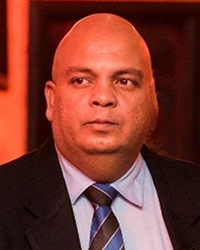
Chameera De Silva
- National Operations Officer, Head – Operations & Migrant Services Unit
- IOM Sri Lanka
What if the greatest vulnerability in border security is not a false document—but a true document telling the
wrong story? That question sits at the heart of the professional journey of Mr. De Silva, a migration-governance
and operational specialist with more than 24 years of experience with the International Organization for
Migration (IOM). A member of IOM Sri Lanka since its establishment in 2002, he currently serves as National
Operations Officer and leads the Operations & Migrant Services (OMS) Unit as a member of the Mission’s senior
management team. Over more than two decades, he has worked at the intersection of migration, identity,
documentary evidence, operational integrity and document fraud risk, while developing and leading services
spanning movement and resettlement, immigration and visa support facilitation, documentary verification,
applicant and establishment assessments and migration advisory services.
What distinguishes Mr. De Silva’s contribution is that he has not simply operated within established systems—
he has built and strengthened them. He was instrumental in establishing and expanding IOM Sri Lanka’s
Operations and Migrant Services Centre in Colombo, creating a comprehensive UN-affiliated platform where
migration services, identity verification, documentary scrutiny and applicant assessment converge. He has also
led programmes aimed at strengthening border-security and migration-governance measures through
systematic documentary and evidentiary verification. This is particularly significant because visa and consular
decision-making generally begin with documentary evidence submitted on paper or in documentary form. By
establishing a robust verification ecosystem that scrutinises the authenticity, integrity, consistency and
evidentiary value of visa and consular documentation before a decision is made by the designated authorities,
his work provides an important upstream safeguard—helping identify document fraud, questionable
documentation and evidentiary inconsistencies before they can influence a visa or consular decision. Most
significantly, he conceived, designed, implemented and led the development of world’s first ISO-certified visa
and consular documentary-evidence verification programme for IOM, transforming more than two decades of
frontline operational knowledge into a structured, measurable, auditable and quality-assured verification
ecosystem.
It is this experience that gives Mr. De Silva a distinctive perspective on the future of border security. The most
consequential risk may not exist within a single document, but in the relationship between documents, the
provenance of evidence, unexplained inconsistencies, or the credibility of the identity story that the evidence
collectively seeks to establish. A document may be technically authentic, yet the evidence surrounding it may be
unreliable; multiple genuine documents may collectively support a misleading identity; and a questionable
evidentiary foundation may pass unnoticed unless the documents are verified through interconnected
ecosystem. His work therefore sits at a critical frontier for modern border management: moving beyond
document verification towards evidence-based identity assurance, proactive fraud mitigation and risk-informed
verification before decisions are made. With extensive operational experience in migration governance,
documentary integrity, fraud prevention and detection, security and operational resilience Mr. De Silva brings to
the World Border Security Conference 2027 not merely a career of experience, but a practitioner’s insight into a
fundamental security challenge: how do we ensure that the evidence presented to a border system is not only
authentic, but trustworthy—and that the identity it establishes is the identity it claims to be!