

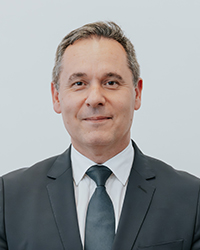
Brigadier General Goncalo Carvalho
- Deputy Secretary-General
- Internal Security System, Portugal
Brigadier General Gonçalo Nuno Silva Gonçalves de Carvalho was born in Santarém on May 23, 1974; he entered the Officers’ Course of the National Republican Guard at the Military Academy in 1992; he was promoted to his current position on January 1, 2025.
Academic qualifications:
Bachelor’s degree in Military Sciences, specializing in the National Republican Guard/Infantry;
Master’s degree in Military Sciences, specializing in Security, awarded by the Military Academy;
Postgraduate degree in Law and Security from Nova University;
attendance of the curricular year of the Doctoral program in Communication Sciences, at the Faculty of Social and Human Sciences, Nova University.
Professional training:
Joint Staff Course of the Spanish Armed Forces;
various specialization courses, including the Public Order Maintenance Course, Traffic Course, Tax Course, and Sniper Shooter Course, taught by the GNR (National Republican Guard).
Course in Light Intervention Teams, from the French Gendarmerie Mobile;
Specialization Course in Information and Security, from the Technical University of Lisbon;
Crisis Management Course, from the National Defense Institute; and
Course in Planning Civil-Military Cooperation Operations, from the Military University Institute.
Professional experience:
throughout his career he has held various positions/roles in GNR (National Republican Guard) and in national and foreign organizations, among which the following stand out:
between 1998 and 2007, he served as Commander of the Special Operations Platoon, Platoon Commander and Public Order Maintenance Company, in GNR Operational Battalion;
during this period he held the following positions abroad (between 2001 and 2002, Liaison Officer, Operations and Public Relations Officer of GNR Rapid Intervention Company, integrated into the United Nations mission in East Timor; Bravo Subgroup, integrated into the United Nations Mission in East Timor);
between 2007 and 2008, Assistant to the Security Officer of the Assembly of the Republic;
between 2009 and 2011, Commander of the Training and Readiness Center for Forces for International Missions and Head of the Training and Capacity Building Section in the GNR Intervention Unit;
between 2011 and 2013, Assistant to the Office of the Commander-General of the GNR, Head of the Communication and Public Relations Division and Spokesperson for the GNR;
between 2014 and 2017, Director of Courses at the GNR and professor at the Military Academy;
between 2017 and 2019, Chief of Staff to the Commander of the Internal Resources Administration Command of the GNR;
between 2019 and 2020, trainer and advisor in the European Union Advisory Mission in Ukraine (EUAM Ukraine);
between 2020 and 2022, 2nd Commander and Commander of the Santarém Territorial Command of the GNR (National Republican Guard);
between 2023 and 2025, Advisor and Director of the Border and Coastal Control Directorate of the GNR Operational Command;
on January 30, 2025, he assumed the role of Director of Operations of the GNR Operational Command.
Now he is Deputy Secretary General of Homeland Security System,
His service record includes several commendations and decorations conferred by national and foreign entities.
Sessions
-
Combatting Transnational Crime
Combatting transnational crime requires a multifaceted approach that encompasses international cooperation, robust legal frameworks, and the use of advanced technology. Transnational crime, which includes Drug Trafficking, Small Arms, Trafficking Illicit Goods, SOC, THB (Trafficking for Organ Harvesting), transcends national borders, making it imperative for countries to work together. Effective collaboration among law enforcement agencies, intelligence sharing, and joint operations can significantly enhance the ability to disrupt criminal networks. Additionally, developing comprehensive legal frameworks that address the unique challenges posed by transnational crime is crucial. This includes harmonizing laws across jurisdictions and ensuring that countries are equipped with the necessary resources and training to tackle this complex issue.
Moreover, technology plays a vital role in combatting transnational crime. The use of data analytics, artificial intelligence, and digital forensics can help identify patterns, track illicit activities, and apprehend criminals more efficiently. By fostering a culture of cooperation, enhancing legal measures, and leveraging technological advancements, the global community can better address the challenges posed by transnational crime and work towards a safer, more secure world.