

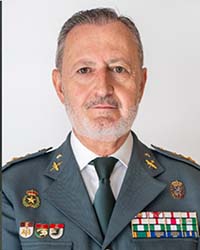
Brigadier General Francisco Rodriguez Lorenzo
- Border and Customs Police Commander
- Guardia Civil, Spain
Brigadier General Francisco Rodríguez Lorenzo serves currently as Commander of the Customs and Borders Command of the Guardia Civil. He is a high-ranking officer with more than 40 years of active service. As Commander, he leads a force of nearly 7.200 personnel integrating 255 customs and border units throughout the country, entrusted for assuring the best and more efficient Border Management tasks in Spain. General Rodriguez previously has been assigned at the Cabinet of the Guardia Civil General Director, at the Guardia Civil Traffic Police Force HQ and Regional Police HQ’s, in all cases serving as Senior Officer for planning and conducting. BG Rodriguez has a University Degree in Political Science and Administration and a Master’s Degree in International Relations –European Union-. He is a General Staff Graduate at the National Defence High Studies Centre in Madrid.
Sessions
-
Combatting Transnational Crime
Combatting transnational crime requires a multifaceted approach that encompasses international cooperation, robust legal frameworks, and the use of advanced technology. Transnational crime, which includes Drug Trafficking, Small Arms, Trafficking Illicit Goods, SOC, THB (Trafficking for Organ Harvesting), transcends national borders, making it imperative for countries to work together. Effective collaboration among law enforcement agencies, intelligence sharing, and joint operations can significantly enhance the ability to disrupt criminal networks. Additionally, developing comprehensive legal frameworks that address the unique challenges posed by transnational crime is crucial. This includes harmonizing laws across jurisdictions and ensuring that countries are equipped with the necessary resources and training to tackle this complex issue.
Moreover, technology plays a vital role in combatting transnational crime. The use of data analytics, artificial intelligence, and digital forensics can help identify patterns, track illicit activities, and apprehend criminals more efficiently. By fostering a culture of cooperation, enhancing legal measures, and leveraging technological advancements, the global community can better address the challenges posed by transnational crime and work towards a safer, more secure world.