

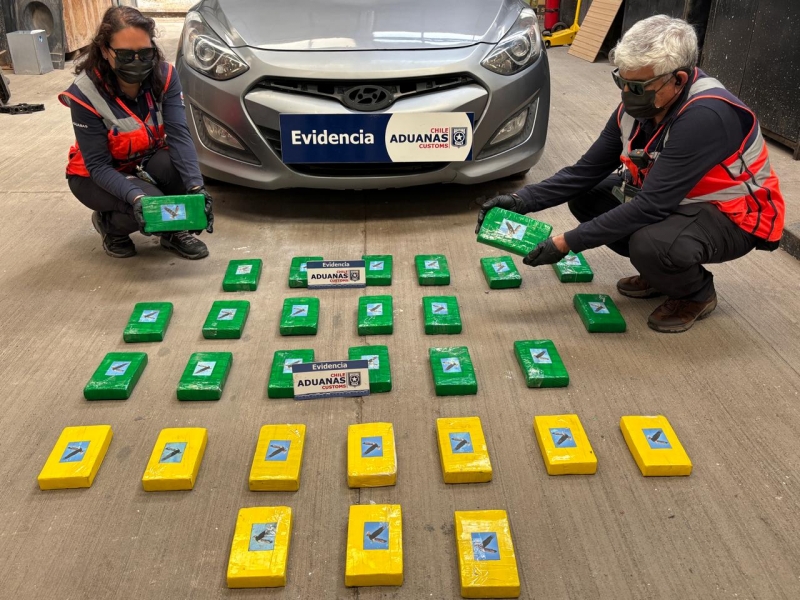
The interpretation of the images obtained by the scanner truck allowed officials from the Chilean Regional Customs Directorate of Arica to detect a vehicle transporting 30 packages hidden in its structure, with a total weight of 30 kilos 970 grams gross of cocaine hydrochloride.
The procedure was recorded on the vehicle inspection track of the Chacalluta Border Complex, when officials from the Drug Enforcement Unit selected a car with Peruvian license plates for inspection.
The vehicle was inspected using a scanner truck, operated by officers from the Non-Invasive Technologies Unit. During the image analysis, the operators noticed anomalies in the car’s structure, specifically in the rocker panel area, which were inconsistent with the vehicle’s normal characteristics.
This initial clue allowed investigators to focus their efforts and conduct a more thorough physical inspection. Upon inspecting the vehicle’s structure, officials found 30 rectangular packages wrapped in green and yellow tape, hidden in the rocker panels.
Subsequent field tests using drug detection equipment yielded a positive result for cocaine hydrochloride. The substance was seized, and the case file was submitted to the Public Prosecutor’s Office, in accordance with established procedure. The official report states that the events were reported as constituting the alleged crime of illicit drug trafficking, in conjunction with smuggling.
Technology and experience to strengthen oversight
The Acting Regional Director of Customs in Arica, James Alarcón, highlighted the coordinated work of the teams and, in particular, the ability of the officials to transform a signal obtained through non-invasive technology into a concrete finding.
“This procedure demonstrates that technology alone is not enough: behind every image are highly trained officials who can interpret it, identify anomalies, and accurately guide the inspection. The combination of technology, experience, and coordinated work allowed us to detect a significant quantity of drugs that was being hidden in the structure of a vehicle,” he stated.
The procedure adds to other results obtained during July at the Chacalluta Border Complex, where the use of technological tools and the application of risk profiles made it possible to detect significant quantities of illicit substances and undeclared goods.
One of the most significant operations that month occurred when TNI operators detected anomalous images on another vehicle with Peruvian license plates. The subsequent physical inspection, conducted jointly with the Drug Enforcement Unit, led to the discovery of 32 packages hidden in the dashboard and doors, with a total gross weight of 33,200 grams of cocaine hydrochloride.
In another discovery, the application of risk profiling allowed authorities to select two female passengers for inspection, which confirmed the presence of packages attached to their bodies. After being analyzed using specialized equipment, the packages tested positive for ketamine, with a total gross weight of 3,660 grams.