

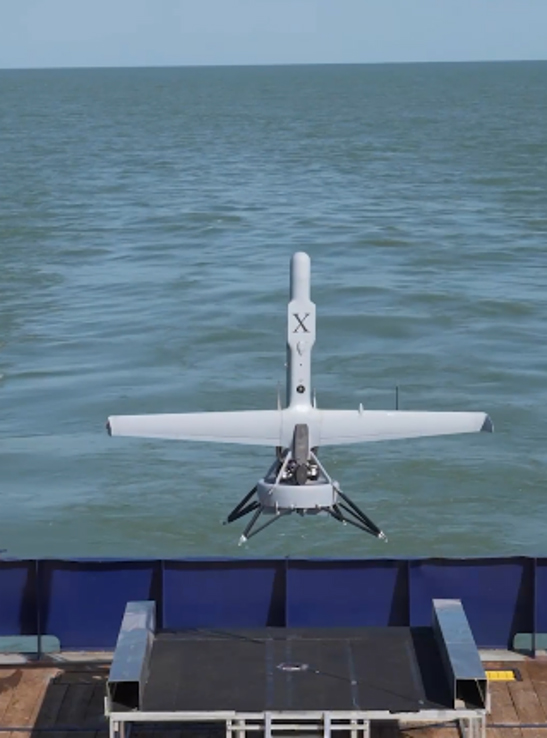
Frontex has completed what is believed to be its most ambitious shipborne drone trial to date, successfully demonstrating how large vertical take-off and landing (VTOL) unmanned aircraft can dramatically extend the surveillance capability of patrol vessels operating in the Mediterranean.
Conducted in partnership with the Italian Coast Guard, the 19-day operational evaluation saw two Shield AI V-BAT unmanned aircraft deployed from the Italian offshore patrol vessel Luigi Dattilo. Rather than operating as stand-alone drones, the aircraft were fully integrated into the ship’s command systems, providing commanders with a real-time operational picture extending up to 150 kilometres beyond the vessel’s own radar and optical sensors.
The trial marks the first time Frontex has operated two drones in the 50-100kg class simultaneously from a patrol ship. Over the course of the evaluation, the aircraft accumulated 150 flying hours, often remaining airborne together for up to 20 hours each day while conducting intelligence, surveillance and reconnaissance (ISR) missions across the central Mediterranean.
Unlike conventional multirotor drones, the V-BAT is a single-engine ducted-fan VTOL aircraft capable of taking off and landing vertically from the confined deck of a patrol vessel before transitioning into efficient forward flight. Its unique design eliminates the need for catapults, arrestor systems or large flight decks, making it particularly attractive for coast guard and naval operators wishing to add airborne surveillance without investing in helicopters.
Manufactured by California-based defence technology company Shield AI, the V-BAT has become one of the fastest-growing tactical ISR platforms in Western service. The aircraft can remain airborne for up to 12 hours, carries a range of electro-optical and infrared payloads, and is designed to operate in electronically contested environments. Its modular architecture also allows operators to integrate maritime surveillance sensors, communications relay payloads and other specialist equipment depending on mission requirements.
However, the significance of the Frontex evaluation extends beyond the performance of a single drone platform. The trial reflects a broader trend across Europe and the maritime security community as agencies seek more affordable and flexible ways to extend surveillance coverage far beyond the horizon without relying solely on traditional crewed aircraft.
The maritime UAV sector has expanded rapidly during the past decade as coast guards, border agencies and naval forces increasingly recognise the value of persistent airborne surveillance.
Advances in sensor technology, autonomous flight control systems and satellite communications have transformed unmanned aircraft from niche capabilities into mainstream operational tools capable of supporting border security, search and rescue, fisheries protection, environmental monitoring and counter-smuggling operations.
Among the most established competitors in this market is the Austrian-built Schiebel CAMCOPTER S-100. The rotary-wing UAV has accumulated thousands of operational hours at sea and has become one of the most widely deployed maritime VTOL platforms worldwide. It has been used by numerous naval forces, coast guards and maritime security organisations, including missions supported through the European Maritime Safety Agency (EMSA). Equipped with electro-optical and infrared sensors, maritime surveillance radar and Automatic Identification System (AIS) receivers, the S-100 offers many of the capabilities now being sought by European maritime authorities.
European manufacturers are also responding to growing demand for shipborne drones. French company Survey Copter is developing vertical take-off variants of its successful Aliaca platform to provide naval and coast guard operators with greater flexibility. The French Navy has openly expressed interest in VTOL solutions that eliminate the need for catapult launches and net recoveries, making drone operations simpler and safer aboard smaller patrol vessels that lack dedicated aviation facilities.
Nor is innovation limited to existing platforms. Schiebel has recently unveiled its next-generation CAMCOPTER S-101 and larger twin-engine S-301 systems, designed to carry heavier payloads, operate over greater ranges and integrate more closely with modern naval command-and-control networks.
These developments illustrate how maritime drones are evolving from simple airborne cameras into sophisticated sensor nodes capable of supporting networked maritime operations.
Not all maritime UAV solutions follow the vertical take-off and landing approach. Fixed-wing systems such as Insitu’s ScanEagle remain widely used across the naval sector because of their exceptional endurance and efficiency. Although they require launch and recovery equipment, fixed-wing platforms can typically remain airborne longer than VTOL systems and are particularly effective when monitoring large maritime areas. They have proven valuable for exclusive economic zone patrols, fisheries protection, anti-smuggling operations and long-range maritime domain awareness missions.
The choice between VTOL and fixed-wing systems often comes down to operational priorities. Fixed-wing aircraft generally offer greater endurance and wider surveillance coverage, while VTOL platforms provide unmatched flexibility for deployment from ships with limited deck space and minimal aviation infrastructure. Many maritime authorities are therefore exploring how different types of unmanned aircraft can complement one another within a wider surveillance architecture.
For Frontex, however, the importance of the V-BAT trial lies less in the aircraft itself than in the concept of operations that it helped validate.
Rather than treating drones as occasional force multipliers, the project sought to determine whether unmanned aircraft could become a permanent extension of a patrol vessel’s sensor suite. During the evaluation, communication antennas, data terminals and control stations were installed directly into the ship’s operations room, allowing the crew to task and monitor the aircraft as naturally as any other onboard system.
Live video feeds were simultaneously transmitted to the vessel and shore-based command centres through Frontex’s Common Operational Picture network, giving commanders ashore immediate access to events unfolding at sea. The exercise effectively demonstrated how shipborne drones can become an integral component of a broader maritime surveillance ecosystem rather than operating as isolated assets.
The operational value of the concept was demonstrated during a live search-and-rescue exercise on 8 July, when one of the drones detected a small inflatable boat well beyond the patrol vessel’s visual horizon. The aircraft tracked the target and assisted the crew in coordinating the simulated rescue, highlighting how unmanned systems could reduce response times while allowing ships to cover significantly larger patrol areas.
The programme was delivered through Greek systems integrator Global SAT, which acted as Frontex’s prime contractor, with Shield AI supplying the aircraft, technical expertise and operational support. As part of the project, the V-BAT also achieved SAIL III authorisation under the European Union Aviation Safety Agency’s Specific Operations Risk Assessment (SORA) framework—currently among the highest operational approvals granted in Europe for this class of maritime unmanned aircraft.
The certification demonstrates that both the aircraft and its operating procedures satisfy the demanding requirements for beyond visual line of sight (BVLOS) operations in European airspace.
Such approvals are increasingly important as agencies seek to integrate larger unmanned aircraft into regular operational service across national borders and within complex maritime environments.
The successful completion of the trial represents another step in Frontex’s wider strategy to modernise Europe’s border surveillance capabilities through the greater use of unmanned systems. As migration pressures, organised crime networks and maritime security challenges continue to evolve, the demand for persistent, cost-effective surveillance is likely to grow.
The agency will now conduct a full assessment of the exercise, and the lessons learned are expected to be shared with EU Member States as they evaluate their own future maritime drone requirements. Importantly, the trial was not simply a test of the V-BAT platform itself, but a demonstration of how drones can be embedded into everyday maritime operations.
As Europe continues to invest in maritime domain awareness, the question may no longer be whether patrol vessels should carry drones, but which type of drone is best suited to the mission. Whether the future lies with VTOL systems such as the V-BAT and CAMCOPTER, fixed-wing platforms like ScanEagle, or a combination of both, the direction of travel appears increasingly clear.
Tomorrow’s coast guard patrol vessels may no longer rely solely on the view from the bridge. Instead, they could routinely operate with persistent aerial surveillance extending hundreds of kilometres beyond the horizon, providing commanders with a level of situational awareness that would have been unimaginable only a decade ago.