

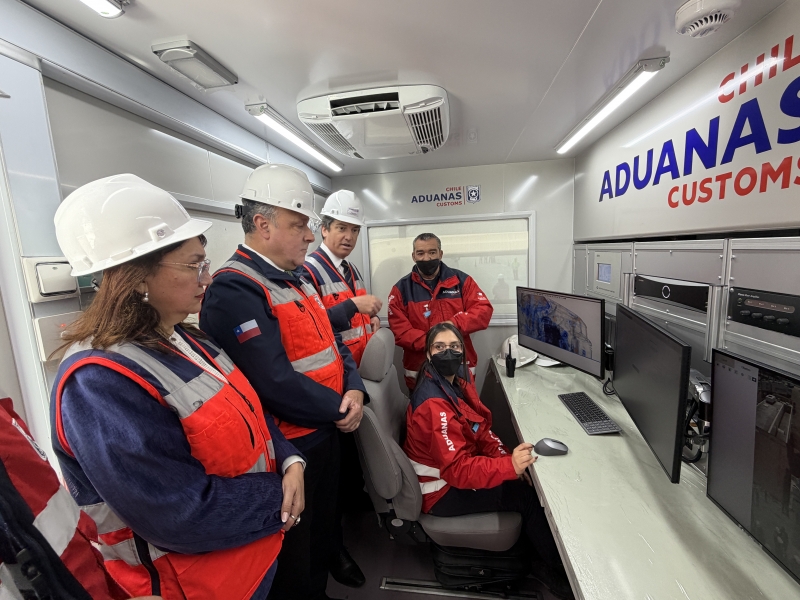
The National Customs Service put into operation two new scanner trucks whose function is to strengthen the control and inspection of goods moved by foreign trade in Chile.
The implementation of this non-invasive technology was led by the Undersecretary of Finance, Sebastián Vallebona and the National Director of Customs (s), María Jazmín Rodríguez, together with the Director of the Valparaíso Regional Customs, Braulio Cubillos, and the regional secretaries of Security and Economy of the Valparaíso Region, Hernán Silva and Cristian Mella.
These acquisitions are part of the National Customs Service’s Non-Invasive Technology (NIT) Renewal Plan, funded through the regular budget, as part of a program to purchase more than 10 new scanner trucks by 2031, further strengthening security at maritime and land borders under Customs jurisdiction. In this case, these scanner trucks are destined for the ports of Valparaíso and Arica.
“This is a significant investment. Currently, the country has 10 mobile scanners, and we are adding two more: one at the port of Valparaíso and the other in the Arica area. The goal is to continue strengthening this investment plan developed by Customs, in conjunction with the Ministry of Finance, to enhance security and combat organized crime, which is so crucial to the safety of this country,” stated Undersecretary of Finance, Sebastián Vallebona.
“It’s a tremendous, quite innovative technology, and the goal is for it to be mobile. Currently, the Valparaíso Region has a portal, which is static, and the idea behind these mobile trucks is that they can move between different border points to provide comprehensive border control. This truck essentially scans the cargo and, therefore, in a non-invasive way, allows for a review of its contents. This, configured with artificial intelligence systems, allows for a second, physical inspection afterward. In this way, we aim for faster inspections so that trade at the ports flows more smoothly,” explained the Finance official.
“This is good news for Chile, because it strengthens the country’s border security, prioritizing the installation of these technologies in the highest risk areas, based on the analysis by Customs experts of foreign trade flows and international travelers in each region,” added the Acting National Director of Customs, María Jazmín Rodríguez.
The authority added that “all foreign trade operations are analyzed based on advance cargo information. This process considers intelligence and risk analysis tools, which allow us to determine which operations require additional controls, such as physical inspection or the use of scanning equipment, which complements this profiling and selectivity work.”
“These technological tools are tremendously important for controlling the flow of international goods. Several operations have taken place where illicit goods such as drugs and contraband have been detected—all of which harm the national economy and the safety of our citizens. Without security, there is no freedom or development, and with these tools, with the work being done by the Government and all the services under its jurisdiction, we are gaining the freedom we all need,” emphasized Regional Security Secretary Hernán Silva.
Foreign trade oversight not only aims to detect smuggling, but also ensures adequate tax collection by Customs to support the implementation of public policies, corresponding to around 28% of total tax revenue and 5% of Gross Domestic Product (GDP).
Between January and September 2026, Customs collected 13,703.2 million dollars (3% more than the same period in 2025), which is equivalent to the construction of 50 hospitals like the Marga Marga Provincial Hospital in the Valparaíso Region (255 billion pesos in investment).
MORE TECHNOLOGIES
Customs currently has 10 operational scanner trucks in the regions of Arica and Parinacota, Tarapacá, Antofagasta, Valparaíso, Biobío, and Los Lagos, in addition to a scanner portal in Valparaíso. With the commissioning of these vehicles, the total number of major TNI (Tariff Identification Number) units will reach 13.
Investments in these types of technologies have been made through the Service’s regular budget and the Secure Border Plan and National Plan Against Organized Crime (PNCO) of the Ministry of Public Security.
It also has 56 pieces of lower-tech equipment that detect the presence or traces of drugs or their components. These include mass spectrometers (which identify traces) and FTIR and Raman spectrometers (which identify narcotics). Additionally, there are nine baggage scanners at various checkpoints and airports throughout the country and two scanners for oversized cargo at the Port of Arica and in the cargo area of Santiago International Airport.
In addition, there are 19 multipurpose canine teams distributed throughout the country, capable of detecting various types of drugs, tobacco or cigarettes, medicines, cash or foreign currency, and weapons.