

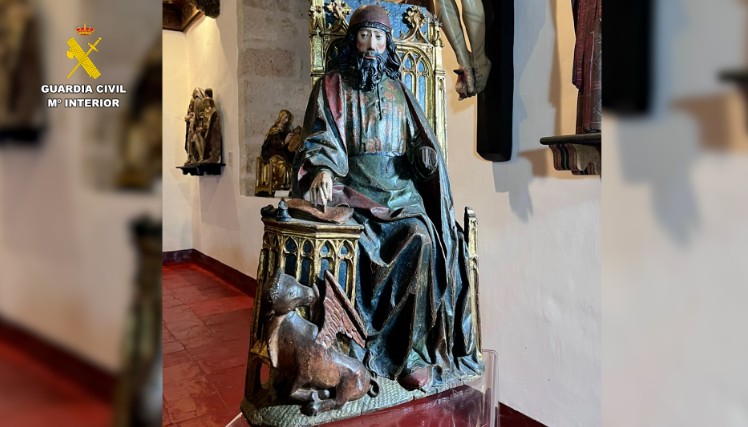
The Spanish Civil Guard, in a joint operation developed with the Command for the Protection of Cultural Heritage of the Carabinieri (TPC), has recovered in Genoa (Italy) a 15th century carving stolen in December 1979 in Astudillo (Palencia), attributed to the famous sculptor Gil de Siloé, and which represents Saint Luke.
This robbery, in which various objects were stolen from the main altarpiece of the Church of Santa Eugenia de Astudillo, is one of the many that plagued the Spanish geography during the 1970s and 1980s.
Operation Predela
The recovery of this piece is the result of an investigation that began in July 2021, when the Civil Guard learned of the location of the carving of Saint Luke in Italy, thanks to the collaboration of some antique dealers, who were interested in acquiring the piece when they saw it put up for sale in a well-known auction house in northern Italy.
They were the ones who later discovered that it was a sculpture stolen in the late 1970s, after compiling much of the information that existed about the work in order to identify it.
It is a polychrome wooden sculpture, about 70 centimeters high, which was part of the main altarpiece of the Church of Santa Eugenia de Astudillo (Palencia), from which six apostles, the four evangelists, a freestanding sculpture and a cross were also stolen on the same day.
A remarkable 15th-century carving
The altarpiece of Saint Eugenia is a work attributed to Gil de Siloé, who was one of the most outstanding figures in Spanish sculpture at the end of the 15th century, when the forms of late Gothic, hybridized by those of Mudéjar art and the Flemish influences of the Flamboyant type, gave rise to what is known as “Isabelline Gothic”, exclusive to Spain.
Once the investigation was launched by the Historical Heritage Section of the Central Operational Unit of the Civil Guard, the complaint filed by the parish priest of the Church of Santa Eugenia in Astudillo (Palencia) was recovered from their archives. Furthermore, thanks to the use of documents and old photographs, it was confirmed that it was indeed the same sculpture.
At the request of the Civil Guard, the Civil and Investigating Section of the Court of First Instance of Palencia, Plaza nº 2, which is leading this investigation, issued a European Investigation Order to Italy in order to proceed with the precautionary seizure of the artwork and thus begin the process of its restitution to Spain. Furthermore, the cooperation of Eurojust was requested, which expedited interjudicial communication.
Finally, 45 years after the theft, the piece was repatriated to Spain last July, thanks to the effective help and collaboration of the Italian judicial and cultural authorities, as well as the Carabinieri, having remained in deposit during these months at the National Sculpture Museum in Valladolid.
Handover ceremony in Palencia
Finally, a ceremony was held at the headquarters of the Diocesan Museum of Palencia to hand over the statue of Saint Luke. Those in attendance included the Bishop of Palencia, the Deputy Director General of Registries and Documentation of the Ministry of Culture, the Director of Cultural Heritage of Castilla y León, the General Chief of the Civil Guard Zone in Castilla y León, and representatives of the Carabinieri Corps.
Example of citizen and institutional collaboration
The recovery of the sculpture is yet another example of the restitution of cultural property achieved thanks to citizen collaboration and, in this particular case, the collaboration of art market professionals, as well as the close institutional cooperation between the Ministries of the Interior and Culture, and the Command for the Protection of Cultural Heritage (TPC) of the Carabinieri in Italy.