

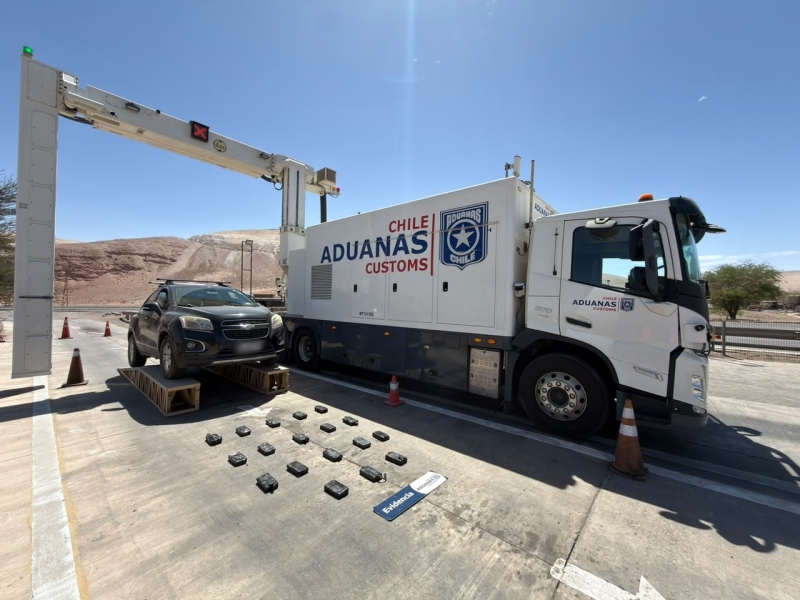
The seizures included cocaine base, cocaine hydrochloride, marijuana, and ketamine, as well as drug-filled capsules. In Quillagua, a new checkpoint using a truck scanner detected 18.8 kilos of cocaine base hidden in a false compartment in a vehicle’s dashboard. In El Loa, an operation coordinated with the Public Prosecutor’s Office and the Investigative Police (PDI) led to the discovery of more than 56 kilos of illicit substances and the arrest of three people.
Nearly 83 kilos of drugs of various types, along with the detection of capsules containing illicit substances and money hidden in a cargo truck, are part of the results of inspections carried out by the Drug Unit teams of the Iquique Regional Customs in Quillagua, Colchane and the El Loa Border Complex.
The findings revealed different methods of concealment, from packages attached to vehicle structures and the bodies of passengers, to substances hidden in footwear, ovoids carried by people, and drugs hidden in a false bottom of the dashboard detected by a scanner truck.
The largest seizure occurred near the El Loa Border Crossing, where coordinated efforts between the National Customs Service, the Public Prosecutor’s Office, and the Investigative Police (PDI) led to the discovery of 14 packages containing 56 kilos and 160 grams of drugs. The discovery stemmed from the inspection of two vehicles, when customs teams detected a strong odor of marijuana and gathered information that directed the search to a nearby area.
At the scene, authorities found two sacks containing ten packages of marijuana, with a gross weight of 52 kilos and 10 grams, and another four sacks containing 4 kilos and 150 grams of cocaine hydrochloride. Following instructions from the Tarapacá Prosecutor’s Office, the operation resulted in the arrest of three people, while the PDI (Chilean Investigative Police) took charge of the seized substances and the ongoing investigation.
Different methods of concealment on buses
At the Quillagua checkpoint, inspectors discovered 4.37 kilograms of cocaine base hidden within the structures of eight pairs of seats on the second floor of a bus traveling from Iquique to Santiago. The packages were secured with magnets and were identified using observation techniques and specialized technology.
In another operation carried out on October 27 at the Quillagua Customs Post, risk profiling for inspection using a truck scanner detected suspicious objects in the dashboard area of a vehicle. A physical inspection identified 18 rectangular packages wrapped in black tape, concealed in a false bottom of the dashboard, in the area of the front air conditioning unit. A field test confirmed the presence of cocaine base, with a gross weight of 18.86 kilograms. The driver was turned over to the Carabineros (Chilean National Police), and the case file, the drugs, and the seized items were transferred to the PDI (Chilean Investigative Police), with notification to the Public Prosecutor’s Office.
At the same checkpoint, a Bolivian passenger traveling from Iquique to Santiago was found to be carrying 142 capsules attached to her body. Analysis confirmed they contained cocaine hydrochloride, with a total weight of 1,570 grams.
Also in Quillagua, the inspection of another passenger bus led to the discovery of 50 ketamine capsules, weighing 565 grams. In addition, 1,045 grams of cocaine base were found hidden in the insoles of the shoes of a Bolivian traveler who was traveling from Iquique to Vallenar.
Meanwhile, at the Colchane Border Crossing, a passenger traveling from Cochabamba to Iquique reported having ingested 90 capsules. Thirty-three capsules were recovered, the contents of which were identified as cocaine base, weighing 406.50 grams.
In another operation at the same border checkpoint, the truck scanner team profiled a Bolivian cargo truck and detected money hidden in a false bottom of its structure. US$251,110, 223,000 Chilean pesos, and 3,940 Bolivian pesos were found.
Ongoing monitoring and detection capabilities
The regional director of Customs in Iquique, Ricardo Aceituno, highlighted the work of the teams and their ability to detect illicit substances through different inspection techniques.
“Drug traffickers may change their methods and seek new ways to conceal the drugs, but our teams are prepared to detect them. Over the past few days, observation, experience, and the use of technology have led to significant discoveries at various checkpoints. Customs remains vigilant: every clue counts, and every inspection is an opportunity to prevent these substances from continuing to circulate,” he stated.
The results come in a context of increased operational demands in the area, due to the damage caused by the August storms to the road infrastructure and the restrictions affecting traffic to the El Loa Border Complex.
The Iquique Regional Customs Office maintains its control operations at points under its jurisdiction and coordination with the relevant institutions, with the purpose of detecting illicit goods and contributing to the fight against drug trafficking.