

Officials from the Antofagasta Regional Customs Office also seized 347 cartons of cigarettes and more than 390 articles of clothing that used trademarks without authorization.
A series of procedures carried out by officials of the Antofagasta Regional Customs Office made it possible to detect 4 kilos 600 grams of cocaine base paste, in addition to contraband cigarettes and clothing that used registered trademarks without authorization.
The findings were made at the Ollagüe border complex and the La Negra Special Surveillance Perimeter (PVE), as part of the controls and operations carried out by the National Customs Service to detect illicit goods or goods seeking to enter the country irregularly.
Two drug raids in Ollagüe
In Ollagüe, customs teams detected two drug-related procedures, in which different inspection tools and techniques were used.
In one of them, a woman was caught transporting 2 kilos 385 grams of cocaine base paste, hidden in a false bottom of a suitcase.
The detection occurred after officers noticed unusual characteristics in the luggage. Upon further inspection, officials discovered the modified structure and a rectangular package concealed inside. A field test yielded a positive result for cocaine.
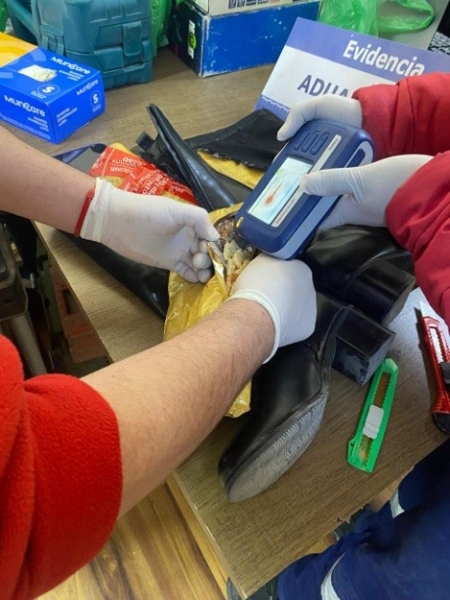
In the second procedure, two other women were detected transporting 2 kilos 215 grams of base paste, distributed in eight packages hidden in the structures of their boots.
In this case, profiling analysis detected irregularities in the footwear worn by the female passengers. Upon closer inspection, officers found two packages concealed in each shoe, weighing 1.1 kilograms in one case and 1.115 kilograms in the other. Subsequent field tests confirmed the presence of cocaine.
The Regional Director of Customs in Antofagasta, Francisco Romero Papasideris, highlighted the ability of the teams to detect different methods used to conceal illicit goods.
“These procedures demonstrate the importance of the specialized work carried out by our officers at the various checkpoints. Those attempting to smuggle illicit goods are constantly seeking new ways to conceal them. Specifically, in these operations, we found false bottoms in luggage in one case, and in the other, envelopes containing cocaine base hidden inside travelers’ shoes. To detect this type of concealment, our team combines experience, risk analysis, and various inspection tools.”
The Regional Presidential Delegate of Antofagasta, Katherine López Rivera, praised the results obtained and highlighted the contribution of border controls to the security of the region.
“The work carried out by Customs officials at our borders is fundamental to preventing the entry of drugs, contraband, and other illicit goods. These results demonstrate that when state institutions strengthen their capabilities and work in coordination, we can better confront those who seek to use our borders to commit crimes.”
Regarding this last case, the head of Briant Calama, subprefect Patricio Méndez Charcas, stated that: “this procedure is part of the work carried out by the PDI, through the San Pedro de Atacama Internal Border Plan, and which includes permanent coordination with the National Customs Service to strengthen the detection of illicit substances at border crossings.
In this case, it was an inspection carried out by Customs officials at the Ollagüe Border Complex that allowed them to detect drugs hidden inside the boots of two Bolivian women, managing to seize more than 2 kilos of cocaine base.
Once the Public Prosecutor’s Office was informed, detectives from the Calama Anti-Narcotics Brigade took over the procedure and carried out the corresponding investigative actions. Both detainees were brought before the courts and remanded in custody, with a 120-day investigation period. This result reflects the importance of inter-institutional coordination and the specialized capabilities of the PDI (Chilean Investigative Police) in combating the entry of drugs into our country across the border.
Cigarettes and clothing at La Negra
Within the control perimeter established in the La Negra sector, inspectors detected 347 cartons of Carnival brand cigarettes being transported as a parcel on a bus, thus initiating a procedure for the crime of smuggling.
At the same location, officials detected another shipment containing 362 sets of sweatshirts and pants that imitated the Adidas brand, in addition to 34 t-shirts corresponding to different sports teams.
The garments were seized after the unauthorized use of trademarks was detected.
New results are added to other procedures in Ollagüe
These findings add to a series of relevant procedures carried out during the last few weeks by the Antofagasta Regional Customs, especially at the Ollagüe checkpoint, where in just two procedures almost 810 kilos of cannabis were detected hidden in tanker trucks.
The first of these discoveries led to the seizure of 457 kilos 350 grams of cannabis, hidden in the tank of a tanker truck, subsequently giving way to coordination and joint proceedings with the Investigations Police and the Public Ministry.
In a second operation, Customs officials discovered another 352.52 kilograms of cannabis, also hidden in the tank of a tanker truck. In this case, coordinated work with the Investigative Police and the Public Prosecutor’s Office allowed them to trace the operation to its final stage, culminating in the arrest of three people.
Also in Ollagüe, Customs officials detected US$36,300 in cash hidden in an international bus coming from Bolivia, while the analysis of images obtained through the scanner truck allowed them to identify an anomaly in another vehicle and subsequently seize more than 30 kilos of cocaine and base paste.