

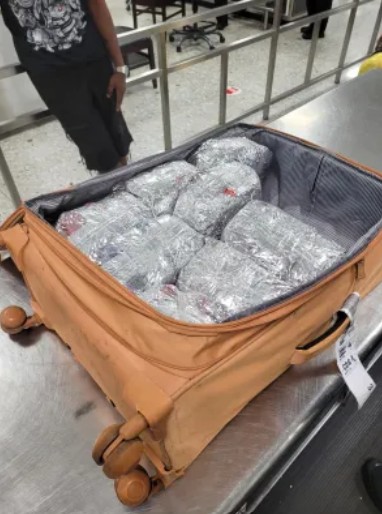
A New York man found himself behind bars on Saturday after U.S. Customs and Border Protection officers seized nearly 368 pounds of khat in his baggage at Washington Dulles International Airport on Friday night.
Metropolitan Washington Airports Authority Police charged Mohamed Diawara, 25, on felony charges of
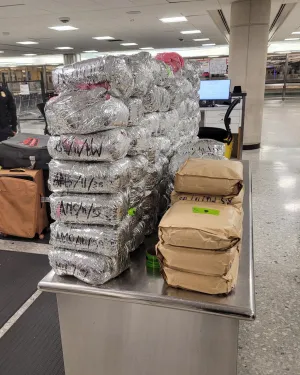
possession with the intent to distribute and transporting a controlled substance into the Commonwealth of Virginia.
CBP officers initially referred Diawara to a secondary inspection after he arrived on a flight from Paris. Officers inspected his eight checked suitcases and discovered a commercial quantity of a dried organic substance. Field tests identified the organic substance as khat (Catha edulis).
The khat weighed a combined 367 pounds, 9 ounces and had a street value of about $44,000.
CBP officers seized the khat and turned Diawara over to MWAA Police officers.
“This is a brazen attempt at smuggling a bulk amount of illegal khat into the United States, but an attempt that failed due to the exceptional work of highly skilled Customs and Border Protection officers,” said CBP Area Port Director Christine Waugh, Area Port of Washington, D.C. “CBP continues to prioritize intercepting dangerous drugs along our nation’s borders, and we work continue to work with our law enforcement partners to hold smugglers accountable.”
CBP officers are seeing an increase in khat being smuggled in traveler baggage. CBP officers at seized 412 pounds of khat and 847 pounds of khat in separate seizures last week at Baltimore Washington International Thurgood Marshall Airport.
Khat, known as Abyssinian tea and African salad, is typically grown in East Africa and the Arabian Peninsula and is chewed for its amphetamine-like effect. Users also boil dried khat leaves to create a stimulant tea.
According to the DEA, khat contains two central nervous system stimulants — cathinone, which is classified as a Schedule I controlled substance, and cathine, a Schedule IV controlled substance. Symptoms of khat toxicity include delusions, loss of appetite, difficulty breathing, and increased blood pressure and heart rate. The World Health Organization classified khat as a drug of abuse in 1980.