

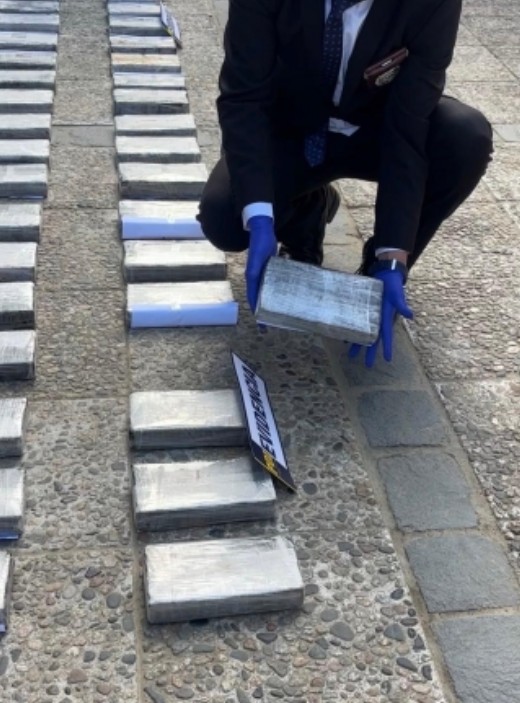
An investigation that lasted more than a year and involved national and international institutions led to the dismantling of a transnational criminal organization dedicated to drug trafficking, with the arrest of 10 people and the seizure of nearly 396 kilos of illicit substances.
The investigation established connections between the organization and criminal structures in various countries and uncovered operations related to the entry, transit, and exit of drugs, including cocaine and ketamine. The investigation also led to the dismantling of a clandestine laboratory and the seizure of vehicles, machinery, and other items used by the organization.
The National Prosecutor, Ángel Valencia, highlighted the importance of coordination between the various institutions and agencies that participated in the procedure.
“We have to protect our ports, because protecting our ports is protecting our economy, it is protecting sources of employment and, to a large extent, what sustains the cities of Valparaíso and San Antonio.”
The National Prosecutor added that the investigation established that the organization had a higher level of complexity than a structure dedicated exclusively to drug trafficking, with international connections and operations.
In this context, the National Customs Service contributed its specialized capabilities for control and information analysis, along with its tools, technology and systems, helping to identify relevant background information for the development of the investigation.
The National Director of Customs, Alejandra Arriaza, highlighted the institutional contribution and the value of coordinated work:
“The National Customs Service has tools, technology and systems, as well as the expert skills and competencies of officials that it makes available in cases like this.”
The authority added that “the most relevant thing” is the interagency work that makes it possible to prevent this type of crime from being carried out across the country’s borders, highlighting that the procedure prevented a significant amount of drugs from leaving the country.
The investigation was carried out jointly by the Public Prosecutor’s Office, the Investigations Police (PDI), its Maritime Police Intelligence Directorate (Dipolmar), the National Customs Service and international agencies from Australia, the United States and Europe.
Prosecutor José Uribe, head of the SACFI of the Valparaíso Regional Prosecutor’s Office, highlighted precisely the international and collaborative nature of the investigation:
“This is an international procedure that we have been working on for more than a year, together with the Chilean Investigative Police, Dipolmar, Chilean Customs and also with international agencies from Australia, the United States and Europe.”
The prosecutor reported that 10 people were arrested —three Colombians, two Mexicans and five Chileans—, who are charged with various actions related to international drug trafficking, including cocaine and ketamine.
The coordination allowed for the gathering of information from different jurisdictions and institutional capabilities, strengthening the identification of routes, operations, and structures associated with the organization. The Chilean Navy’s Maritime Police, the Australian Border Force (ABF), and the U.S. Drug Enforcement Administration (DEA) also collaborated in the operation.
According to Hernán Silva, the regional secretary of Public Security for the Valparaíso Region, the procedure demonstrates the capacity of state institutions to act in a coordinated manner against organized crime.
“These types of procedures demonstrate the power of the Chilean State to confront crime.”
The authority also highlighted the joint work of the PDI, the Chilean Navy, Customs and the Public Prosecutor’s Office, emphasizing institutional coordination as a central element to achieve results against international criminal organizations.
The operation represents a blow to the logistical and operational capacity of an organization with international connections and prevented a significant amount of drugs from reaching illicit markets in other countries.
For Customs, the procedure reaffirms the importance of putting its analytical, control, technological and specialized knowledge capabilities at the service of complex investigations, strengthening the coordinated action of the State against transnational organized crime.