

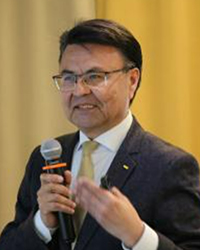
Otabek Rashidov
- Programme Officer, Action Against Terrorism Unit
- Organization for Security & Co-operation in Europe (OSCE)
Otabek Rashidov is a Programme Officer at the Action against Terrorism Unit within the Transnational Threats Department of the OSCE Secretariat. In this capacity, he develops and implements capacity-building initiatives and coordinates the organization’s efforts to counter the use of the internet for terrorist purposes.
Rashidov joined the OSCE Secretariat in 2018 after seven years with the OSCE Project Co-ordinator in Uzbekistan, where he managed a broad portfolio of projects focused on combating illicit drug trafficking, countering terrorism, and strengthening border security and cybersecurity. His earlier professional experience includes serving as a Political and Security Advisor to Japan’s International Co-operation Agency in Tashkent, as well as a decade of work in various roles within Uzbek law-enforcement institutions.
He holds a Master’s degree in ICT and Applied Mathematics from Tashkent State University and a Master of Public Administration with a concentration in International Development from the University of York in the United Kingdom. In 2023, he further expanded his academic credentials by completing a Professional Master’s degree in Artificial Intelligence at the Rome Business School.
Sessions
-
Use of AI at the Border
Artificial Intelligence in the Context of Preventing and Countering Violent Extremism and Terrorism: Challenges, Risks and Opportunities
AI is increasingly playing a pivotal role in enhancing border security systems, utilizing advanced technologies to improve surveillance, threat detection, and data analysis. Currently, AI-driven solutions such as facial recognition, predictive analytics, and autonomous drones are employed to monitor borders efficiently and accurately. These systems can analyse vast amounts of data in real-time, enabling authorities to identify potential risks and respond swiftly to security threats. In the future, we can expect even more sophisticated applications of AI, including the integration of machine learning algorithms that continuously adapt and improve based on evolving threats. Innovations such as biometric sensors and AI-enabled surveillance systems will likely create a more secure environment while balancing the need for privacy and ethical considerations. As technology continues to evolve, AI will remain a cornerstone in shaping the landscape of border security, ensuring safer and more effective management of national boundaries.