

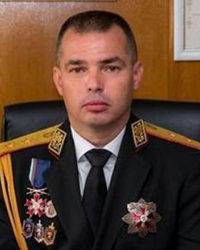
Anton Zlatanov
- Chief Commissioner
- General Directorate Border Police
Chief Commissioner Anton Zlatanov, PhD, is the Director General of General Directorate “Border Police in the Republic of Bulgaria. With more than 25 years of experience in the Ministry of Interior, his career is marked by many professional achievements.
Mr. Zlatanov progressed through all levels of the system. His professional career began in 1997 as a police officer at the Security Police department and later worked at the Criminal Police department. He has held various positions including senior police officer and inspector at Sofia Metropolitan Directorate of Interior, later becoming a member of the Specialized Police forces. In 2015, he was appointed as a Deputy Director of Sofia Metropolitan Directorate of Interior, as he served as Director of the same unit in May-June 2021.
In terms of his educational experience, Mr. Zlatanov was granted a PhD in the field of National security in 2016. He has also attended trainings at Interpol and the European Police College, as well as courses at various police academies and schools in Europe. He is renowned lecturer, leading the “Security and countering radicalization and terrorism” Master’s degree both at Military Academy “G.S. Rakovski” and the MoI Academy.
Sessions
-
Combatting Transnational Crime
Implemented Measures by General Directorate “Border Police” in Order to Tackle Irregular Migration and Cross-border Crime
Combatting transnational crime requires a multifaceted approach that encompasses international cooperation, robust legal frameworks, and the use of advanced technology. Transnational crime, which includes Drug Trafficking, Small Arms, Trafficking Illicit Goods, SOC, THB (Trafficking for Organ Harvesting), transcends national borders, making it imperative for countries to work together. Effective collaboration among law enforcement agencies, intelligence sharing, and joint operations can significantly enhance the ability to disrupt criminal networks. Additionally, developing comprehensive legal frameworks that address the unique challenges posed by transnational crime is crucial. This includes harmonizing laws across jurisdictions and ensuring that countries are equipped with the necessary resources and training to tackle this complex issue.
Moreover, technology plays a vital role in combatting transnational crime. The use of data analytics, artificial intelligence, and digital forensics can help identify patterns, track illicit activities, and apprehend criminals more efficiently. By fostering a culture of cooperation, enhancing legal measures, and leveraging technological advancements, the global community can better address the challenges posed by transnational crime and work towards a safer, more secure world.